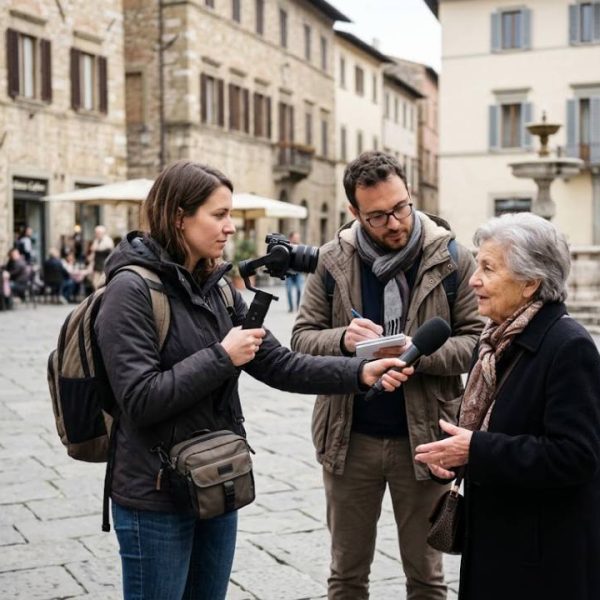
For most of the last century, media literacy was something you met once, in a classroom, probably around the age of fifteen. A teacher held up a front page, asked who paid for it, and the class nodded. The lesson could stop there because the media environment was small enough to fit inside one room. A handful of broadcasters, a stack of national papers, and a working assumption that somebody holding a press card had checked the thing before it reached you.
That arrangement has quietly collapsed. The checking still happens, in plenty of places, but it no longer happens between the event and your eyes. It happens afterwards, in public, sometimes days later, and usually in a different tab from the one where you saw the claim. Which means the checking has been outsourced, at least partly, to you.
What Media Literacy Actually Means Now
Ask ten people what media literacy is and you will get ten versions of "not believing everything you read." That is not wrong, but it is thin. The useful definition is closer to this: the ability to work out where a piece of information came from, what it was made for, and what it leaves out. Origin, intent, omission. Everything else is detail.
The academic framing of media literacy has been around since the 1970s and covers access, analysis, evaluation and creation. The creation part matters far more than it used to. Anyone with a phone is now a publisher, which means the audience and the press are drawing from the same well and using the same tools. The old line between the people who make media and the people who consume it has thinned to almost nothing.
The Speed Problem
Most bad information is not clever. It is simply early. A photograph from a protest in 2019 gets attached to a protest in 2026, and it travels for six hours before anyone thinks to run it through a reverse image search. By then the correction reaches a fraction of the original audience, and that fraction has already made up its mind.
This is why advice on how to spot fake news tends to fail when it arrives as a list of warning signs. Bad grammar, sensational headlines, suspicious domains: these catch the crude fakes, and the crude fakes were never the difficult part. The real problem is accurate material presented inside a misleading frame. A genuine quotation with the question removed. A real statistic detached from its denominator. Authentic footage from the wrong week.
The habit that works is duller than any checklist. Before sharing, find the same claim somewhere that has a name, a masthead and something to lose. If you cannot find it, wait. Waiting costs you nothing, and it is the single most effective thing an ordinary reader can do.
When a Story Crosses a Language Border
Something happens to information when it changes language, and very few readers account for it. A claim reported carefully in Portuguese can arrive in English stripped of its hedges, because hedging words are the first casualty of a hurried translation. Machine tools have made cross-border reporting enormously more available, and the surge in translation AI news coverage reflects how fast audiences adopted them, but availability is not the same thing as fidelity.
Marketers learned this expensively, and their errors are better documented than journalism's. The catalogue of global brand failures caused by weak localization is really a catalogue of what happens when nobody asks a native speaker to read the copy before it ships. News carries the same risk at higher stakes. If you are reading a story that began life in a language you do not speak, that is worth holding in mind.
The same fidelity problem decides outcomes far from any newsroom. When a document carries legal weight, an approximate rendering is not a stylistic flaw but a liability, which is why courts, registries, and immigration authorities insist on certified translation services backed by translation memory and terminology checks. Those CAT features keep names, dates, and formulaic clauses identical across every page, so a file cannot quietly contradict itself. Verification, in other words, is a property of the process and not just of the individual translator.
Why This Is a Newsroom Problem
There is a temptation for reporters to file all of this under somebody else's department. Education's problem. The platforms' problem. It is neither. A newsroom publishing into an audience with no working method for judging sources is publishing into noise, and it will lose that audience to whoever happens to be loudest.
Sorting reliable information from noise is partly a technical skill and partly a matter of temperament. The older discipline of stoicism is unexpectedly practical here, because it trains attention on what is actually within your control and quietly discards the rest. A calmer reader is usually a more accurate one.
Media literacy has a straightforwardly financial application. Investment coverage of emerging markets is written for an audience that will not check the underlying filings, and optimistic framing survives longer than it should. Reading critically is a practical skill for anyone deciding whether to invest in thailand on the strength of a headline.
The practical response is a kind of transparency that used to be considered unnecessary padding. Say how you know something. Link the document. Name the limits of what you have actually confirmed. Explain, briefly, why a story is running today rather than yesterday. Reporters arguing this out in places like the r/Journalism community tend to reach the same conclusion from different directions: showing your work is now part of the work, not an appendix to it.
Three Questions That Do Most of the Work
If the entire field had to be compressed into something usable at speed, it would come down to three questions. Who is telling me this, and how would they know? What would I expect to see if this were false, and do I see it? And who benefits if I believe it and pass it along?
None of these require expertise. They require about eleven seconds and a willingness to be slightly less certain than the person who posted it. The reason media literacy is important comes down to simple arithmetic: those eleven seconds, multiplied across an audience, are the difference between a rumour that dies quietly and one that ends up quoted in a parliamentary debate.
A Habit, Not a Course
None of this is something you complete. It is closer to physical fitness, in that it decays without use and nobody can do it on your behalf. The reader who checks one claim a day is in far better shape than the reader who once sat through a very good seminar and has coasted on it since.
For anyone producing this material, the standard is simply the one journalism always claimed for itself. Show where it came from. Say plainly what you do not know. Assume the person reading is capable of handling a complicated answer, because on current evidence they are getting a great deal of practice.